
This post contains affiliate links. As an Amazon Associate I earn from qualifying purchases.
If you’ve always wanted to make a Brussels sprouts salad but felt intimidated, this is your starting point. I’m going to walk you through every single step like we’re standing together in your kitchen. This isn’t a fancy restaurant dish that requires special skills—it’s a real meal that I’ve made hundreds of times, and it costs less than $8 for a generous serving.
Whether you’re nervous about raw Brussels sprouts, unsure how to slice them, or worried the dressing will taste off, I promise you this recipe meets you exactly where you are. And if you’re looking for other approachable veggie-forward meals, check out my Roasted Cauliflower Tacos with Chipotle Romesco—another weeknight win that teaches similar knife skills.
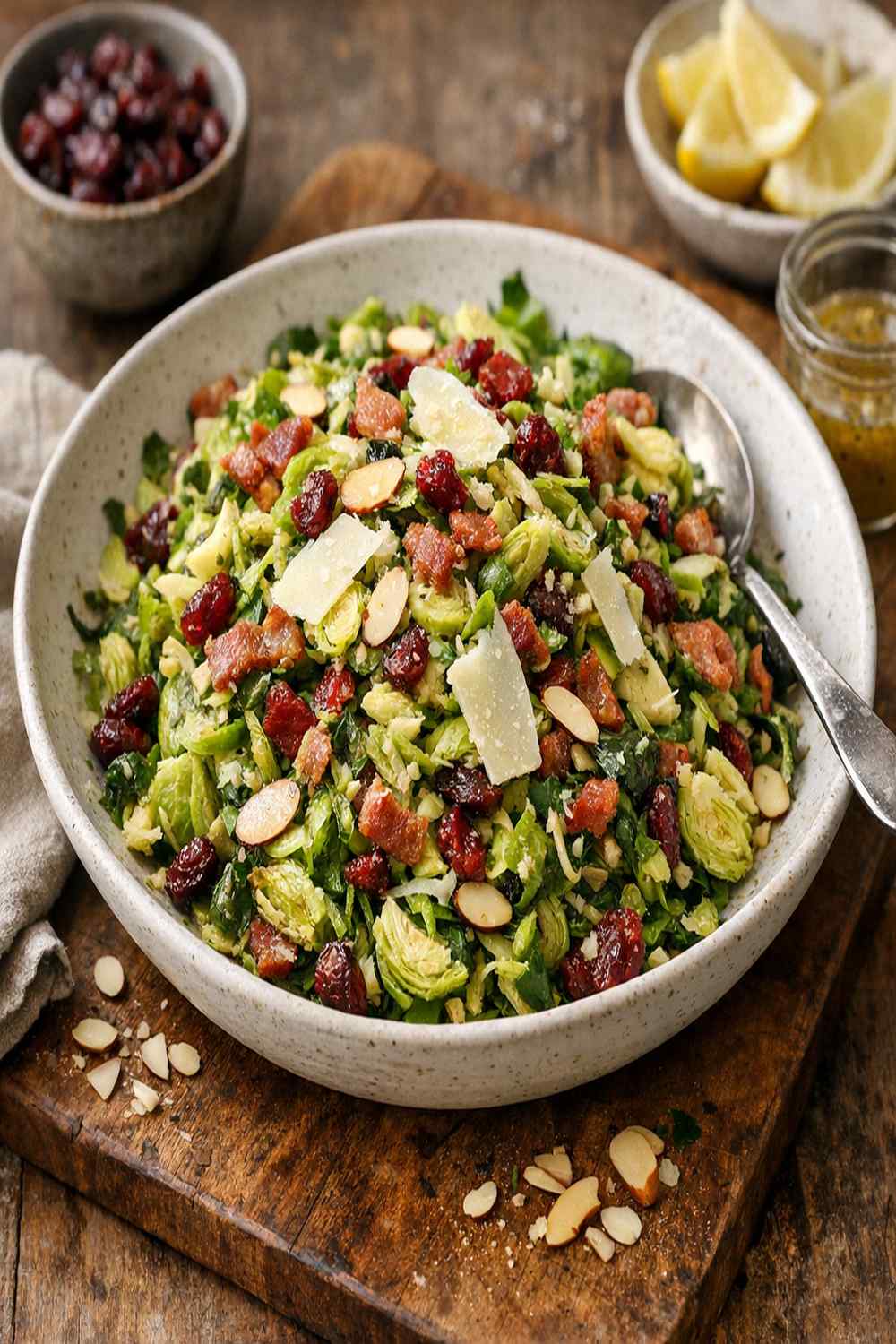
How to Make Brussels Sprouts Salad for the First Time (You’ve Got This)
I remember the first time I served a raw Brussels sprouts salad, I was terrified. I’d grown up eating Brussels sprouts roasted until they were almost burnt—my grandmother’s way—and the idea of eating them raw felt wrong somehow. But one autumn evening in my early nutrition practice, a client brought me a raw shredded Brussels sprouts salad with apples and a tangy dressing, and something clicked.
The raw sprouts were crisp and tender at the same time, nothing like what I expected. I went home and made my own version using ingredients I already had in my pantry, and my family ate the entire bowl without asking questions.
That’s when I realized this recipe could change how people see affordable, wholesome eating. It’s not complicated. It’s not expensive. And it genuinely tastes like something you’d pay $14 for at a café.
What to Expect Before You Start
Before we dive in, let’s set realistic expectations so there are no surprises. This salad comes together in about 15 minutes from start to finish, though most of that time is just shaving the Brussels sprouts. The actual cooking is zero—everything is raw.
You’ll need a clean workspace and basic kitchen tools. Success looks like a bowl of paper-thin green and white shreds coated in a glossy, slightly tangy dressing that smells like apples and mustard.
- The shaving takes a few minutes but feels magical once you start. Most beginners worry they’ll hurt themselves or the Brussels sprouts won’t shave thin enough. Truth: if you use a food processor, it practically does the work for you. If you use a sharp knife or mandoline, it’s actually meditative once you find your rhythm.
- The dressing comes together in one small bowl with zero fuss. You’re not emulsifying anything tricky or tempering anything. Just whisk, taste, adjust. Done.
Equipment You’ll Need (And What You Can Skip)
I’m a big believer in not buying kitchen gadgets you’ll use once. So here’s what you actually need for this salad, and what I’d suggest skipping unless you make it regularly.
- A sharp knife or mandoline – You need something that can slice Brussels sprouts paper-thin. A mandoline is faster but a sharp 8-inch chef’s knife works perfectly fine. If you have a food processor with a slicing blade, even better—that’s my go-to. Budget alternative: any sharp knife you already own. If it struggles, sharpen it first (a dull knife is actually less safe).
- A large mixing bowl – Standard size is fine. You’re just tossing everything together.
- A small jar or bowl for the dressing – I prefer a mason jar because you can shake it, but a regular bowl and whisk works just as well.
- A whisk or fork – To combine the dressing ingredients. A fork honestly works fine.
- A cutting board – For prepping the apple and garlic.
- Nice to have but not required: a salad spinner – If your Brussels sprouts feel damp after shaving, a spinner dries them quickly. If you don’t have one, pat them with a clean kitchen towel.
The Ingredients – A Beginner’s Shopping Guide
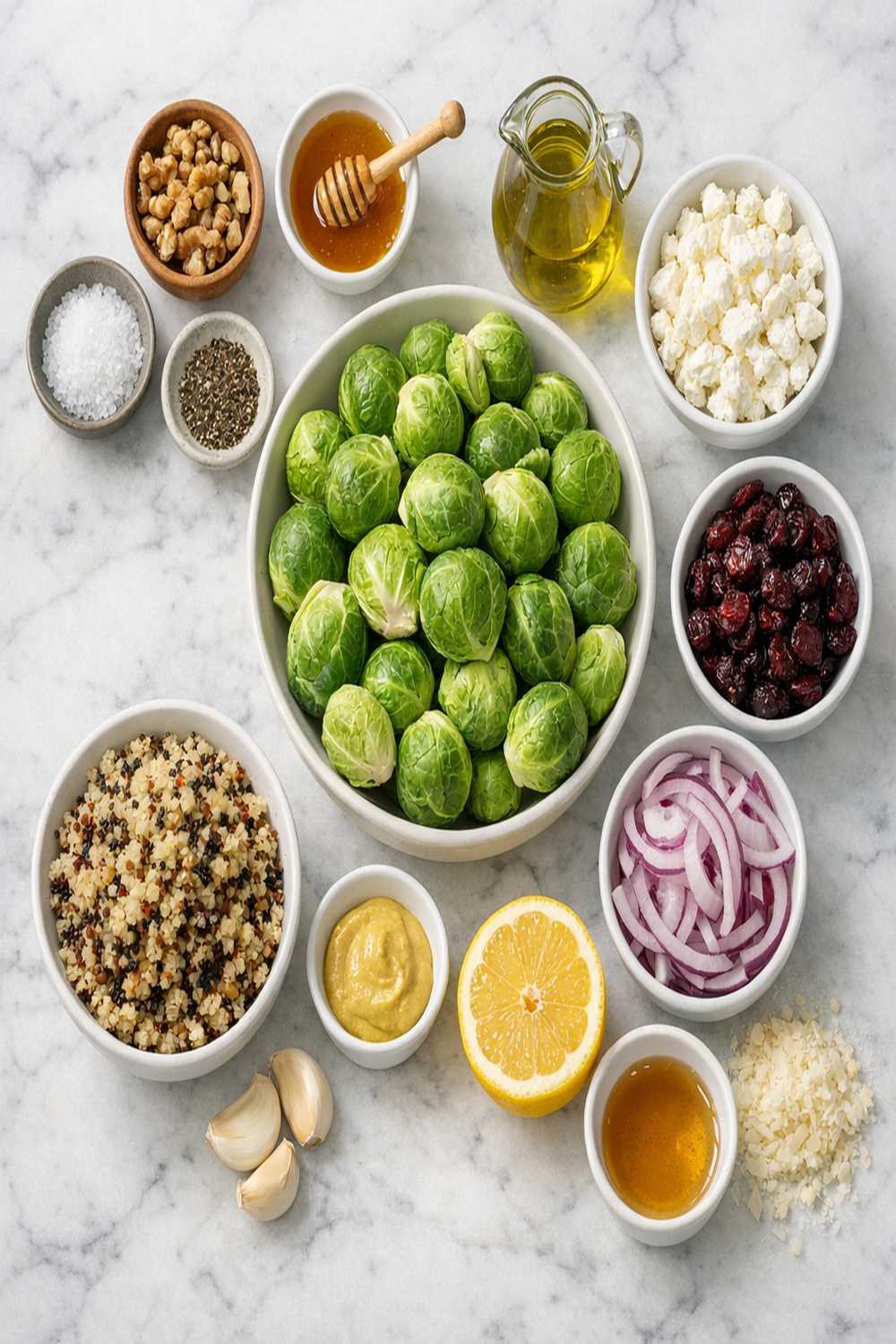
Every single ingredient in this salad serves a purpose, and I’ve chosen them specifically because they’re affordable and available at any grocery store. I’m also going to give you honest swaps because I know your pantry might look different from mine. When you’re shopping, aim for medium-sized Brussels sprouts (they’re more tender), the crispest apple you can find, and pure maple syrup—not pancake syrup, which tastes completely different and costs about the same.
- 1 pound Brussels sprouts (look for firm, bright green heads without yellow leaves; they’ll feel heavy for their size and should snap when you bend them)
- ½ cup dried cranberries (regular dried, not the sugary kind; or swap for dried cherries or raisins if that’s what you have)
- 1 clove garlic (minced fine; if you don’t have fresh, ¼ teaspoon garlic powder works in a pinch)
- 1 large Honeycrisp apple or 2 smaller apples (any crisp apple works—Granny Smith, Pink Lady, or Gala are all good budget alternatives)
- ½ cup raw sunflower seeds (look in the snack aisle or bulk section; pumpkin seeds work too, or chopped walnuts if you prefer)
- 2 teaspoons Dijon mustard (the kind in a small jar near the yellow mustard; Grey Poupon or store brand both work)
- 1 tablespoon fresh lemon juice (one fresh lemon squeezed, or bottled works in a pinch)
- Kosher salt and freshly ground black pepper (to taste)
- ⅓ cup shredded or shaved Parmesan cheese (the pre-shredded kind is fine; if you want to save a dollar, you can use half the amount and it’s still delicious)
- 1 tablespoon pure maple syrup (not imitation—it makes a real difference)
- 2 tablespoons apple cider vinegar (the slightly cloudy kind with the “mother” tastes best but regular filtered works too)
- ⅓ cup extra virgin olive oil (use what you have; it doesn’t need to be expensive, just something you’d drizzle on bread)
Budget swaps that work: Use white vinegar if you don’t have apple cider. Swap dried cranberries for raisins (actually cheaper). If Parmesan is pricey, use half the amount or skip it entirely—the salad is still wonderful. Can’t find sunflower seeds? Chopped almonds, walnuts, or even toasted breadcrumbs add that satisfying crunch.
Step-by-Step: Your First Brussels Sprouts Salad
You’re ready. Seriously. I’m going to walk you through this like you’ve never made a salad before, because some people haven’t, and that’s completely okay. Take your time. There’s no rush, and honestly, the slower you go, the better you’ll understand each step so you can make this again without thinking twice.
Step 1: Make Your Maple Mustard Dressing
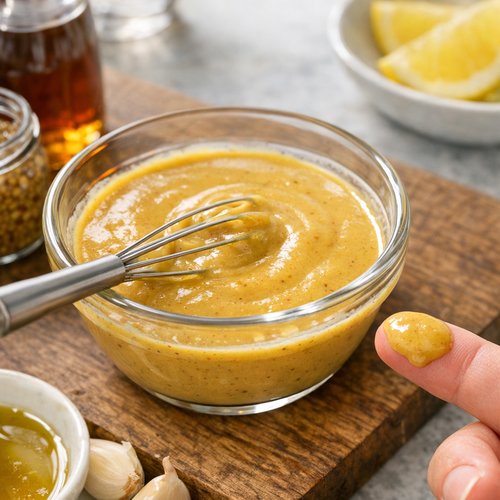
Start here because the dressing is the easiest part and it gives you confidence immediately. Find a small bowl or a mason jar—whichever feels comfortable in your hands. Pour in ⅓ cup of olive oil. The oil should look greenish or golden, not clear. Add 1 tablespoon of fresh lemon juice (if you’re squeezing a fresh lemon, cut it in half and twist it hard over a small bowl, catching any seeds). Next, add 2 tablespoons of apple cider vinegar—you’ll smell it immediately, a little sharp and apple-like.
Now add 1 tablespoon of pure maple syrup. This is what makes the dressing special. Maple syrup adds a subtle sweetness that balances the vinegar’s tang. Add 2 teaspoons of Dijon mustard—it will look like a small dollop of brownish paste. If you minced your garlic, add 1 small clove now (about the size of a pea, minced as small as you can). If you don’t have fresh garlic, skip it or add a pinch of garlic powder.
Now whisk or shake everything together until it’s smooth and combined. If you’re using a jar, screw the lid on tight and shake for about 30 seconds. If you’re using a bowl, whisk for about 1 minute. The dressing should look slightly creamy and golden, not separated. Taste a tiny bit on your finger—it should taste tangy, slightly sweet, with a little mustard kick. If it tastes too vinegary, add a touch more maple syrup. If it’s too sweet, add a squeeze more lemon. Salt and pepper it lightly. Set it aside.
Step 2: Prepare Your Brussels Sprouts
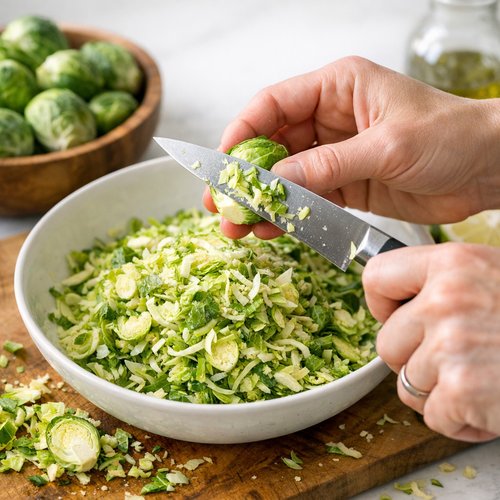
This is where the magic happens. Take your pound of Brussels sprouts and look them over. You’ll see a stem at the bottom and leaves starting to peel back. Trim the stem end off each one—just slice about ¼ inch off the bottom where the stem gets woody. Rinse them quickly under cool water and pat them dry with a clean kitchen towel. Wet Brussels sprouts won’t shave nicely, so take a minute to dry them well.
Now, if you have a food processor, this is where it earns its keep. Fit the food processor with the slicing blade (not the chopping blade—that’s important). Add your Brussels sprouts and pulse until they’re shaved into paper-thin ribbons. You should see mostly light green and white, which is the inside of the sprout. This takes about 30 seconds.
If you don’t have a food processor, use a mandoline slicer or a sharp knife. Hold the Brussels sprout firmly by the stem end (careful of your fingers), and slice downward as thinly as you can. You want each piece to be about the thickness of a playing card. It sounds fussy, but after the first Brussels sprout, your hands know what to do. The whole process takes maybe 5 minutes for a pound.
Once all your Brussels sprouts are shaved, place them in your large mixing bowl. They should look like a pile of pale green and white shreds. If they feel at all damp, pat them with a towel again.
Step 3: Prepare Your Apple and Other Mix-Ins
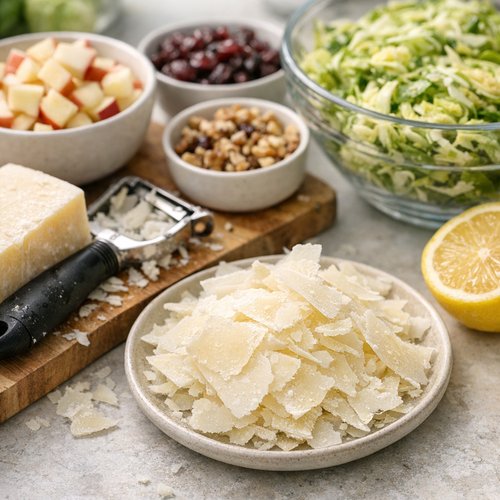
While your Brussels sprouts are in the bowl, let’s prep the rest. Take your Honeycrisp or other crisp apple. Do not peel it—the skin has fiber and color, and it’s perfectly fine to eat raw. Slice the apple in half from top to bottom. Scoop out the seeds with a small spoon. Now chop the apple into roughly ½-inch pieces—they don’t need to be perfect. You’ll have maybe ½ to ¾ cup of chopped apple.
Measure out ½ cup of dried cranberries. If they seem hard or sticky, that’s normal. Add them to the bowl with the Brussels sprouts. Measure ½ cup of sunflower seeds and add those too. Finally, measure ⅓ cup of shredded or shaved Parmesan cheese and add it. If you’re using the block kind and shaving it yourself with a vegetable peeler, that works too—it’ll be in bigger flakes, which is lovely.
Everything should be sitting in the bowl now, still dry, just waiting for the apple and dressing. Add your chopped apple to the bowl.
Step 4: Bring It All Together
This is the moment where a pile of separate ingredients becomes an actual salad. Pour your maple mustard dressing over everything in the bowl. Don’t be shy—use all of it. Now, take two large spoons or salad servers and toss everything together using a scooping, turning motion. Lift from the bottom, flip it over the top, and repeat. Do this for about 1 to 2 minutes until every shred of Brussels sprout is coated in the glossy golden dressing.
As you toss, you’ll notice the Brussels sprouts start to soften slightly and release a tiny bit of moisture—this is exactly what you want. The dressing will cling to everything. Stop when you see no more white shreds peeking through without dressing. Taste a small bite. It should taste bright, slightly sweet, and balanced. Add a pinch of kosher salt and a grind or two of fresh black pepper, toss once more, and taste again. Adjust if needed.
How to Tell If You Did It Right
Success in this salad looks and feels a very specific way, and I’m going to tell you exactly what to look for so you never second-guess yourself.
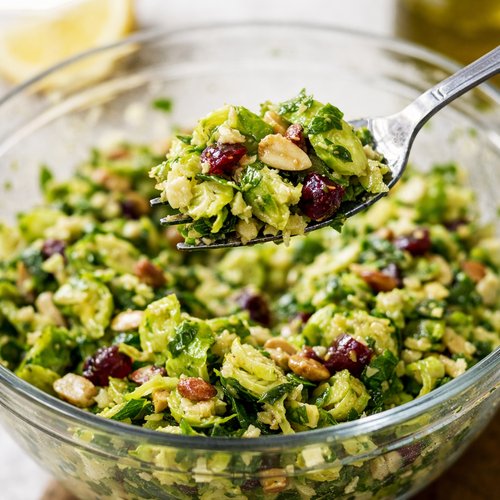
- The Brussels sprouts are paper-thin and slightly tender to bite. When you take a fork and eat a piece, it should have just a tiny bit of resistance but not be crunchy like raw cabbage. If it’s still very brittle and hard, your slices were too thick—no big deal, it still tastes great, but now you know.
- The dressing coats everything and makes the salad glisten. When you look at the bowl, you should see a glossy sheen, not a pool of dressing at the bottom. If liquid is pooling, your Brussels sprouts were too wet before you started, or you used too much dressing. Just drain a little off.
- The smell is bright and apple-forward with a mustard undertone. Your nose should pick up the apple and vinegar first, then the Dijon. If it smells strongly of garlic or is overwhelming, you may have added too much—next time use half a clove.
- The flavor is balanced—tangy, slightly sweet, with a hint of nuttiness from the Parmesan and seeds. No single flavor dominates. If it tastes too vinegary, you know to reduce vinegar next time. If it’s too sweet, less maple syrup next time.
What Went Wrong? Beginner Fixes
I’ve made this salad probably 300 times, and I still occasionally have a moment where something doesn’t feel right. Here’s what happens and how to fix it instantly.
- The Brussels sprouts feel mushy or too soft within an hour. This happens when your sprouts were wet before you shredded them, or you over-tossed the salad after dressing it. The dressing draws out moisture. Fix: Make sure you dry your Brussels sprouts thoroughly before shredding. Next time, wait to add the dressing until just before serving if you need this to last longer. The good news: even mushy Brussels sprouts still taste good, they’re just less crisp.
- The dressing separates or looks oil-slicked on top. This usually means you didn’t whisk long enough, or the ingredients weren’t at the same temperature. Fix: Whisk again for a full minute. If that doesn’t work, it’s fine—just toss the salad more vigorously when combining. The flavors are still perfect.
- The salad tastes too vinegary or sour. You either used more vinegar than intended or didn’t add enough maple syrup to balance it. Fix: Drizzle a little more maple syrup over the top, toss, and taste. Problem solved in 30 seconds.
- The apples turned brown while you were prepping. This is oxidation, totally harmless, but if it bothers you, toss the apple in a tiny bit of lemon juice right after chopping. Store-bought lemon juice works for this.
- You forgot to add the dressing and tossed it all dry. This happens to me when I’m teaching others. Just pour the dressing on now and toss. Honestly, the salad still tastes great—the flavors all meld together in a few minutes even if you’re late to dress it.
Your Next Steps After Mastering This
Once you’ve made this Brussels sprouts salad a couple of times, you’ve actually learned some foundational skills that open up so many other recipes. You understand how to slice vegetables thin (which means you can make coleslaw, vegetable thinly sliced sides, or salads with any raw vegetables). You’ve made a vinaigrette from scratch, which means you can dress any salad you dream up. And you’ve discovered that raw vegetables are actually interesting and delicious when they’re prepared the right way.
Next, try making this same dressing for raw kale, spinach, or cabbage. Or use what you learned about making vinaigrettes to create your own dressing using Balsamic Glaze as a base. You could even chop up roasted vegetables like the ones in my Roasted Cauliflower Tacos with Chipotle Romesco and dress them this same way. The skills are transferable, and once you see that, you’ll never feel stuck in the kitchen again.
Can I Store Brussels Sprouts Salad?
Yes and no, and let me explain what I mean. If you store this salad after dressing it, the Brussels sprouts will continue to soften and release moisture, and it gets less crispy. That said, it still tastes wonderful and keeps well.
Storage timeline for a dressed salad: Eat it immediately for the crispiest texture. If you need to store it, cover it and refrigerate for up to 2 to 3 hours maximum. After that, the sprouts get noticeably softer, though the flavor is still great.
Better option: Make it ahead but dress it later. Shred and prep all the ingredients—Brussels sprouts, apple, cranberries, seeds, Parmesan—and store them together in an airtight container for up to 24 hours. Keep the dressing in a separate container in the fridge. When you’re ready to eat, combine and dress. This way, you get the crisp texture right before serving but save yourself the chopping time.
Storage for undressed ingredients: Shredded Brussels sprouts in an airtight container keep for 3 to 4 days in the fridge. The dressing keeps for 1 week in a jar. So you could actually make multiple salads throughout the week with minimal effort—just dress what you need each day.
Nutrition Information
According to USDA nutritional databases, one serving of this Brussels sprouts salad (approximately 2 cups) contains roughly 280 calories, with 18 grams of fat (mostly from the olive oil and seeds), 8 grams of protein (from the Parmesan and seeds), and 22 grams of carbohydrates (from the apple and cranberries). The fiber content is significant at 4 grams per serving, which supports digestive health.
From a registered dietitian perspective: What makes this salad nutritionally valuable isn’t just the numbers—it’s what those numbers represent. You’re getting raw, intact Brussels sprouts, which means you’re consuming active enzymes and fat-soluble vitamins (like vitamin K) that support bone health. The apple provides soluble fiber, which helps stabilize blood sugar. The sunflower seeds contribute vitamin E and selenium, both powerful antioxidants. The maple syrup, while technically a sugar, contains minerals like manganese and zinc that refined white sugar doesn’t have. And the apple cider vinegar may help with satiety. This isn’t a salad you’re eating because you “should”—it’s a salad your body actually recognizes and uses.
This recipe makes approximately 4 generous servings as a side dish, or 2 main-course servings if served with a protein like grilled chicken, baked fish, or legumes.
What Can I Serve With Brussels Sprouts Salad?
This salad is flexible as a side, but it truly shines alongside proteins and grains. It’s acidic and slightly sweet, so it pairs beautifully with rich or savory foods that benefit from that brightness.
- Grilled chicken breast or thighs – The acidity of the dressing cuts through the richness of the meat perfectly. This is my go-to weeknight dinner combination.
- Baked salmon or white fish – The apple and cranberry notes complement the subtle sweetness of fish beautifully.
- Roasted pork tenderloin – The mustard in the dressing echoes the flavors in pork seasoning, making it feel intentional and elegant.
- Creamy soups like butternut squash or potato – Serve the salad on the side to add texture and brightness to a heavier meal. Try it with my Baked Eggs with Spinach for a complete brunch or lighter dinner.
- Grains like farro, quinoa, or brown rice – Toss the salad directly into warm grains for a hearty grain bowl. The dressing will coat everything and create a cohesive dish.
- Alongside legumes – Black beans, lentils, or chickpeas pair wonderfully. The brightness balances the earthiness of legumes.
Expert’s Nutritional Tip: Why Brussels Sprouts Deserve More of Your Attention
As a registered dietitian, I notice that most people avoid Brussels sprouts because they remember them as bitter, overcooked, and mushy from childhood meals. But here’s what nutrition science shows: raw or lightly cooked Brussels sprouts contain a compound called sulforaphane, which has been studied extensively for its anti-inflammatory and potentially cancer-preventive properties.
The moment you heat Brussels sprouts significantly, some of that sulforaphane breaks down. Eating them raw—like in this salad—preserves that compound while also maintaining the bright, nutty flavor that makes people actually want to eat them.
This is why I rarely roast Brussels sprouts anymore. I shred them raw, dress them, and watch people ask for seconds. You’re not just eating vegetables; you’re actually absorbing nutrients your body can use effectively.
Make-Ahead Guide: Plan Your Week
One of the biggest advantages of this salad is how it fits into a busy life. Here’s my professional meal-prep approach:
Sunday Prep (30 minutes of work): Wash and trim all your Brussels sprouts. Shred them using a food processor. Spread the shreds on paper towels to dry completely—about 10 minutes. Transfer to an airtight container and refrigerate. Make your dressing in a jar and refrigerate separately. Chop your apples and store in a separate small container. Put your cranberries and sunflower seeds in their own containers. Everything now lasts in your fridge for up to 24 hours.
Assembly (5 minutes): Each time you want to eat, take a portion of the Brussels sprouts, add the cranberries, seeds, apple, and Parmesan, drizzle with dressing, toss, and go. Because you prepped everything, you have a fresh, crispy salad without any work on busy evenings.
Meal-Prep Timing: If you’re prepping for the entire week, shred your Brussels sprouts on Sunday but only dress the portion you’ll eat that day or the next day. By Wednesday, even refrigerated shredded Brussels sprouts begin to oxidize and soften. However, the undressed shreds keep for 4 days, so you could make two salads on Sunday and Wednesday with fresh dressing each time.
Seasonal Variations: Make This Year-Round
This recipe is perfect in fall and winter, but you can absolutely adapt it for other seasons:
Spring version: Replace the dried cranberries with fresh or frozen peas. Use a fresh lemon vinaigrette instead of maple mustard—skip the maple syrup, add more lemon juice, and use fresh herbs like dill or tarragon. Substitute fresh mint for some of the Parmesan.
Summer version: Use shredded raw zucchini or yellow squash mixed with the Brussels sprouts to lighten it. Replace dried cranberries with fresh berries or diced fresh peaches. Keep the maple mustard dressing but add fresh basil right before serving.
Winter version: This is the one I make as written—it’s a winter salad through and through. But you could add pomegranate seeds instead of cranberries in December for extra festivity.
Year-round hack: The dressing stays the same all year, which is why I love this recipe. You can literally change every other ingredient based on what’s seasonal and cheap, and the maple mustard dressing ties it all together perfectly.

Brussels Sprouts Salad Recipe
Ingredients
Method
- Start here because the dressing is the easiest part and it gives you confidence immediately. Find a small bowl or a mason jar—whichever feels comfortable in your hands. Pour in ⅓ cup of olive oil. The oil should look greenish or golden, not clear. Add 1 tablespoon of fresh lemon juice (if you’re squeezing a fresh lemon, cut it in half and twist it hard over a small bowl, catching any seeds). Next, add 2 tablespoons of apple cider vinegar—you’ll smell it immediately, a little sharp and apple-like. Now add 1 tablespoon of pure maple syrup. This is what makes the dressing special. Maple syrup adds a subtle sweetness that balances the vinegar’s tang. Add 2 teaspoons of Dijon mustard—it will look like a small dollop of brownish paste. If you minced your garlic, add 1 small clove now (about the size of a pea, minced as small as you can). If you don’t have fresh garlic, skip it or add a pinch of garlic powder. Now whisk or shake everything together until it’s smooth and combined. If you’re using a jar, screw the lid on tight and shake for about 30 seconds. If you’re using a bowl, whisk for about 1 minute. The dressing should look slightly creamy and golden, not separated. Taste a tiny bit on your finger—it should taste tangy, slightly sweet, with a little mustard kick. If it tastes too vinegary, add a touch more maple syrup. If it’s too sweet, add a squeeze more lemon. Salt and pepper it lightly. Set it aside.
- This is where the magic happens. Take your pound of Brussels sprouts and look them over. You’ll see a stem at the bottom and leaves starting to peel back. Trim the stem end off each one—just slice about ¼ inch off the bottom where the stem gets woody. Rinse them quickly under cool water and pat them dry with a clean kitchen towel. Wet Brussels sprouts won’t shave nicely, so take a minute to dry them well. Now, if you have a food processor, this is where it earns its keep. Fit the food processor with the slicing blade (not the chopping blade—that’s important). Add your Brussels sprouts and pulse until they’re shaved into paper-thin ribbons. You should see mostly light green and white, which is the inside of the sprout. This takes about 30 seconds. If you don’t have a food processor, use a mandoline slicer or a sharp knife. Hold the Brussels sprout firmly by the stem end (careful of your fingers), and slice downward as thinly as you can. You want each piece to be about the thickness of a playing card. It sounds fussy, but after the first Brussels sprout, your hands know what to do. The whole process takes maybe 5 minutes for a pound. Once all your Brussels sprouts are shaved, place them in your large mixing bowl. They should look like a pile of pale green and white shreds. If they feel at all damp, pat them with a towel again.
- While your Brussels sprouts are in the bowl, let’s prep the rest. Take your Honeycrisp or other crisp apple. Do not peel it—the skin has fiber and color, and it’s perfectly fine to eat raw. Slice the apple in half from top to bottom. Scoop out the seeds with a small spoon. Now chop the apple into roughly ½-inch pieces—they don’t need to be perfect. You’ll have maybe ½ to ¾ cup of chopped apple. Measure out ½ cup of dried cranberries. If they seem hard or sticky, that’s normal. Add them to the bowl with the Brussels sprouts. Measure ½ cup of sunflower seeds and add those too. Finally, measure ⅓ cup of shredded or shaved Parmesan cheese and add it. If you’re using the block kind and shaving it yourself with a vegetable peeler, that works too—it’ll be in bigger flakes, which is lovely. Everything should be sitting in the bowl now, still dry, just waiting for the apple and dressing. Add your chopped apple to the bowl.
- This is the moment where a pile of separate ingredients becomes an actual salad. Pour your maple mustard dressing over everything in the bowl. Don’t be shy—use all of it. Now, take two large spoons or salad servers and toss everything together using a scooping, turning motion. Lift from the bottom, flip it over the top, and repeat. Do this for about 1 to 2 minutes until every shred of Brussels sprout is coated in the glossy golden dressing. As you toss, you’ll notice the Brussels sprouts start to soften slightly and release a tiny bit of moisture—this is exactly what you want. The dressing will cling to everything. Stop when you see no more white shreds peeking through without dressing. Taste a small bite. It should taste bright, slightly sweet, and balanced. Add a pinch of kosher salt and a grind or two of fresh black pepper, toss once more, and taste again. Adjust if needed.
FAQs
Can I use a store-bought coleslaw mix instead of shredding my own Brussels sprouts?
Technically yes, but I wouldn’t recommend it. Most store-bought coleslaw mixes contain cabbage, which has a different texture and flavor than Brussels sprouts. The taste won’t be quite the same. That said, if you’re in a time crunch or physically unable to shred, pre-shredded Brussels sprouts are sold in some grocery stores near the salad kits. They cost more but save you the work. If that’s your only option, go for it—the salad is still delicious.
What if I don’t have maple syrup? Can I use honey or agave?
Yes, absolutely. Honey and agave both work as sweeteners in the dressing. Honey will give you a slightly warmer sweetness, and agave is more neutral. Use the same amount (1 tablespoon). The dressing might taste slightly different—honey-based will be more floral, agave will be cleaner—but both are delicious. If you have regular white sugar, dissolve 1 teaspoon in a tiny bit of warm water to make a simple syrup, then use that in your dressing. Avoid corn syrup or pancake syrup, which taste too artificial.
Is this salad vegan or gluten-free?
The base salad is naturally vegan and gluten-free except for the Parmesan cheese. If you need it to be fully vegan, skip the Parmesan or use Vegan Parmesan Cheese. All the other ingredients are naturally plant-based and grain-free, so it works perfectly for those diets with that one swap.
Can I make this salad warm or cooked somehow?
You can, though you’d be changing the whole concept of the recipe. If you want warm Brussels sprouts with a similar flavor profile, sauté shredded Brussels sprouts in olive oil for 3 to 4 minutes until they soften, then toss with the same dressing and let it cool slightly. Add the apple and other ingredients after cooling. But honestly, the raw version is what makes this special—the crispness is the point. If you’re in the mood for warm, roasted Brussels sprouts, that’s a different recipe altogether.
The dressing looks separated. Did I do something wrong?
No, and this is totally normal. Oil and vinegar naturally separate—that’s just chemistry, not user error. Before you toss the salad, whisk the dressing again for about 30 seconds. Or just pour the separated dressing over your salad and toss vigorously; the action of tossing will combine everything. After you toss the salad, the dressing will cling to the vegetables and stay incorporated.
How spicy is the mustard? My kids don’t like strong flavors.
Dijon mustard isn’t spicy—it’s tangy and a bit sharp, but not hot. However, it’s definitely noticeable. If your kids are sensitive to that flavor, reduce the mustard to 1 teaspoon instead of 2. Or skip it entirely and add ½ teaspoon of honey and a tiny pinch of salt instead. The dressing will taste different but still be good. You might also try letting the salad sit for 15 minutes after dressing—sometimes the flavors mellow and become less intense as they meld together.
More Beginner-Friendly Recipes
- my weeknight pasta – Learn how to cook fresh asparagus and toss it with simple pasta. Uses similar knife skills and takes just as little time.
- Roasted Cauliflower Tacos with Chipotle Romesco – Another veggie-forward recipe that teaches you how to make raw vegetable-based meals feel substantial and satisfying.
- Affordable Salad Recipe -Affordable Food Ideas
- 3 Bean Recipe Salad
- Simple French Style Potato Salad
- Garlicky Kale Salad with Crispy Chickpeas